Python vs JavaScript for Beginners: Which First Language Should You Learn?

Starting programming from a blank file can feel like standing at a crossroads. Two roads appear immediately: Python and JavaScript. Both are popular, well documented, and capable of powering real applications. The useful question is not which language is universally better, but which one gives you the clearest path from curiosity to competence.
Many beginners ask: should I learn python or javascript first as a beginner? The answer depends on what you want to build, how you like to receive feedback, and how much setup you are willing to manage before writing your first useful program.
What Python and JavaScript Are Designed to Do
Python is a general-purpose language used in data analysis, automation, artificial intelligence, scientific computing, web backends, and scripting. Its design emphasizes readable syntax and a small number of obvious ways to express common operations. That makes Python approachable when you are learning variables, loops, functions, and problem decomposition for the first time.
JavaScript is the native language of the web browser. It controls what happens when a page loads, how a button responds, and how data moves between a site and a server. With Node.js, the same language can also run on a server. That reach makes JavaScript especially appealing if your goal is to create interactive websites or full-stack web applications.
Syntax and the First Week of Learning
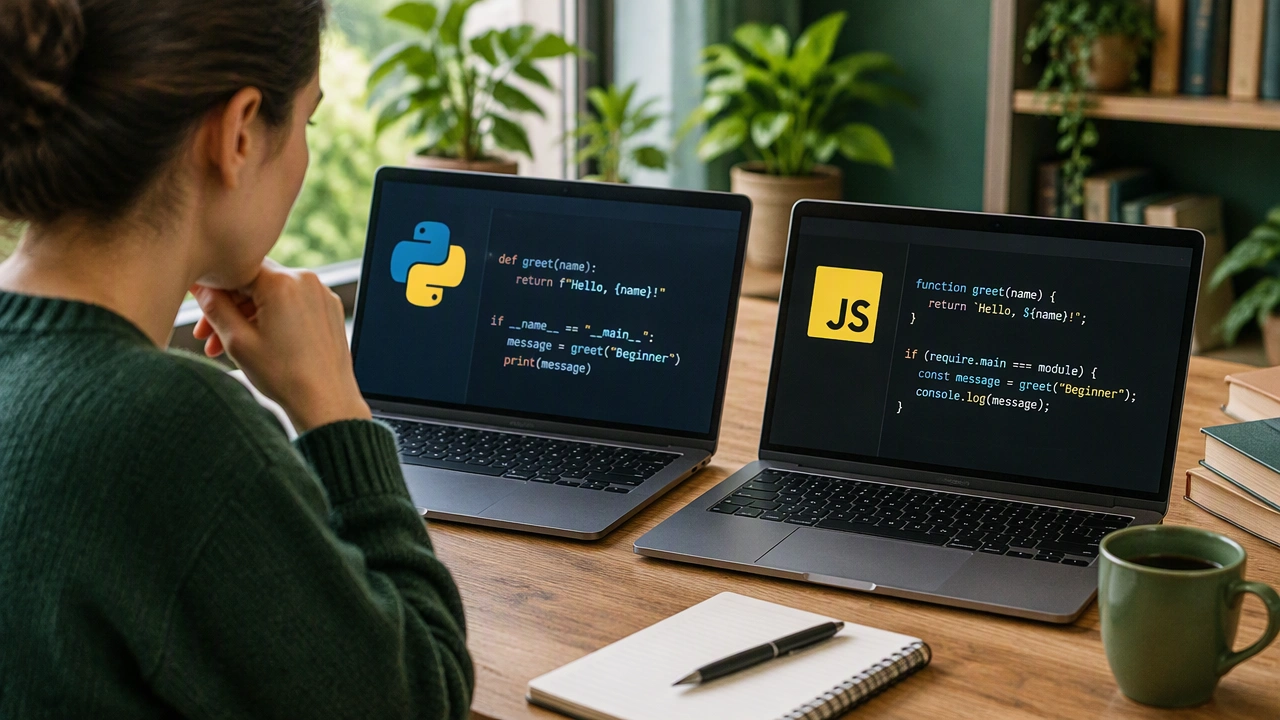
Python uses indentation to define blocks and generally requires less punctuation. A simple program can look close to plain English:
print(“Hello”)
JavaScript also has a gentle entry point, but it introduces more symbols early: semicolons, curly braces, parentheses, and keywords such as const and let. A browser console example might be:
console.log(“Hello”);
Neither syntax is difficult, but Python often creates fewer visual distractions in the first few lessons. JavaScript asks you to understand a little more structure before the code feels tidy. If you prefer immediate clarity, Python may feel calmer. If you are excited by web pages and willing to absorb extra symbols, JavaScript may feel more motivating.
Where You See Results
Feedback speed matters more than people expect. Python makes it easy to run small scripts and see output in a terminal. You can read a file, transform data, or automate a repetitive task within an hour of learning. The result is useful even if it is not visual.
JavaScript gives faster visual feedback when you are building for the browser. Change a line of code, refresh the page, and a button may change color or a list may reorder. That immediate connection between code and interface can sustain motivation. On the other hand, browser tools, event listeners, and asynchronous behavior add concepts that beginners must eventually confront.
Tools and Setup
Python setup is straightforward: install the interpreter, open an editor, and run a file. Popular editors such as VS Code make the process simple. You may encounter package management later with tools like pip, but the first program does not require a project framework.
JavaScript can run in the browser with no installation, which is a major advantage. For larger projects, you will eventually meet Node.js, npm, bundlers, and build tools. Those tools are valuable in professional work, but they can make a beginner project feel complicated before the core language has clicked.
Projects That Teach the Right Lessons
A good first project should teach programming ideas, not only framework instructions. Python is strong for projects such as:
- a number-guessing game
- a to-do list stored in a text file
- a command-line expense tracker
- a script that renames or organizes files
- a simple data summary from a CSV file
JavaScript is strong for browser projects such as:
- a quiz with score tracking
- a countdown timer
- a weather interface using a public API
- an interactive memory game
- a personal portfolio with dynamic navigation
Both lists teach variables, conditionals, loops, functions, and debugging. Python projects often emphasize data and automation. JavaScript projects often emphasize state, user events, and interface behavior.
Errors, Debugging, and Confidence
Beginners sometimes judge a language by how it handles mistakes. Python errors are usually descriptive and point to a line with a readable message. JavaScript errors can also be precise, but browser behavior sometimes hides the source of a problem behind layers of event handlers or asynchronous code.
Debugging is a skill, not a personality test. Whichever language you choose, learn to read error messages slowly, reproduce the problem with the smallest possible example, and print intermediate values when necessary. Confidence grows from this process more than from avoiding errors entirely.
Career Direction and Learning Transfer
If your goal is data science, machine learning, automation, or scientific work, Python aligns closely with the tools used in those fields. If your goal is front-end development, web products, or full-stack work, JavaScript is the more direct route.
Neither choice traps you. Syntax and programming concepts transfer. After learning Python, moving to JavaScript means learning new conventions and web concepts. After learning JavaScript, moving to Python means adjusting to different syntax and a different ecosystem. The first language is a starting point, not a permanent identity.
A Practical Way to Choose
Choose Python if you want a gentle syntax, terminal-based experiments, data-oriented tasks, or automation scripts. Choose JavaScript if you want to build web interfaces, see visual changes quickly, or work toward front-end and full-stack development.
If you still cannot decide, run the same tiny exercise in both languages. Print a message, ask for input, and solve a small condition. Notice which environment keeps you curious. Then commit to one language for four to six weeks and finish one complete project before comparing options again.
The blank file is not a test of talent. It is simply the place where a first habit begins. Pick the path that gives you a reason to return tomorrow, and let consistent practice turn uncertainty into skill.